This is a short 10-minute online quiz on material properties in Design Technology. Answer all questions. Some questions require you to select the correct answer, others require a short written response or filling in the blank. For questions with data, refer to the provided chart or table to answer. The total marks for this quiz are 15.
Which property describes the ability of a material to be stretched into a wire without breaking?
Ductility
Brittleness
Hardness
Malleability
Ductility is the property that describes the ability of a material to be stretched into a wire without breaking. Materials with high ductility, such as copper, can be drawn into thin wires, making them useful for electrical wiring and similar applications.
Hardness
The correct answer is "Hardness." Hardness is a material property that measures how resistant a material is to scratching, indentation, or abrasion. Materials with higher hardness are more difficult to scratch or indent.
A material that absorbs energy and deforms plastically without fracturing is considered tough.
This statement is True. Toughness is the ability of a material to absorb energy and plastically deform without fracturing. Tough materials can withstand impacts and are less likely to break suddenly.
Which of the following materials is most likely to be used where electrical conductivity is important?
MDF
Copper
Balsa
Acrylic
Copper is most likely to be used where electrical conductivity is important because it is an excellent conductor of electricity. Materials like balsa, acrylic, and MDF do not conduct electricity well.
A student wants to test the brittleness of four different materials. Which test would be most suitable?
Scratching the materials to see if they leave a mark
Hammering the materials to see if they flatten
Heating the materials to see if they melt
Bending the materials to see if they snap
Bending the materials to see if they snap is the most suitable test for brittleness. Brittle materials break or snap when bent, while ductile or malleable materials may bend or deform without breaking.
The ability of a material to be shaped or flattened into thin sheets by hammering or rolling is called malleability
The correct answer is "malleability." Malleability is the property of a material that enables it to be hammered or rolled into thin sheets without breaking.
Which property is being tested when a material is exposed to repeated bending until it breaks?
Plasticity
Fatigue resistance
Toughness
Elasticity
Fatigue resistance is the property being tested when a material is repeatedly bent until it breaks. Fatigue resistance measures how well a material can withstand repeated cycles of stress before failing.
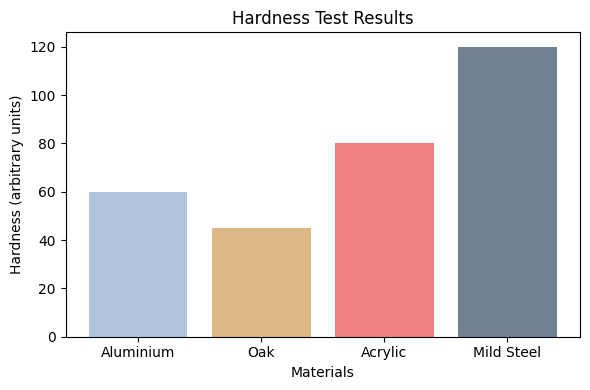
Refer to the following data chart showing the results of a hardness test for four materials:

Which material is the hardest according to the chart?
Mild Steel
Oak
Acrylic
Aluminium
According to the chart, Mild Steel has the highest hardness value among the four materials tested. Therefore, Mild Steel is the hardest.
Match the property to its correct definition: a) Elasticity
b) Durability
c) Plasticity
a) Elasticity - 2. Ability to bend and return to original shape
b) Durability - 1. Ability to withstand wear, pressure, or damage
c) Plasticity - 3. Ability to permanently change shape
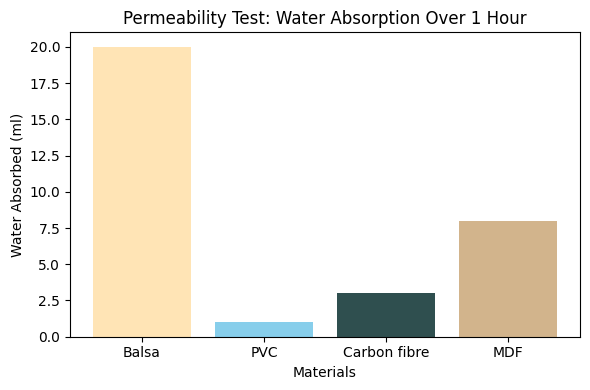
The following materials are tested for their permeability to water: Balsa, PVC, Carbon fibre, and MDF. The bar chart below shows the amount of water absorbed (ml) over 1 hour.

Which material is most permeable?
Balsa
Carbon fibre
PVC
MDF
According to the chart, Balsa absorbs the most water in one hour, indicating it is the most permeable material among those tested.